Welcome to Tiger Freethinkers!

We are a freethinking group, a fellowship of Thomasians who value reason, science, secularism, and freedom of speech.

Opinions and News Articles

Read up on Culture and History, Politics, Sciences, Religion and Secularism .

External Links

More reading materials about Freethought and Secularism

Tiger Freethinkers Online Library

Browse through our collection of additional reading materials. Available for download.

Tiger Freethinkers News

Updates, announcements, projects, Facebook discussions, meet up dates and more.

Sapere Aude: Dare To Know

Join our call for secularism and the right to be informed. Join Tiger Freethinkers now!

Showing posts with label News Articles. Show all posts

Sunday, May 19, 2013

Science, Religion and the Environment

What follows is the January 1990 text, sent by scientists to religious leaders, of "Preserving and Cherishing the Earth: An Appeal for Joint Commitment in Science and Religion."

The Earth is the birthplace of our species and, so far as we know, our only home. When our numbers were small and our technology feeble, we were powerless to influence the environment of our world. But today, suddenly, almost without anyone noticing, our numbers have become immense and our technology has achieved vast, even awesome, powers. Intentionally or inadvertently, we are now able to make devastating changes in the global environment—an environment to which we and all the other beings with which we share the Earth are meticulously and exquisitely adapted.

We are now threatened by self-inflicted, swiftly moving environmental alterations about whose long-term biological and ecological consequences we are
still painfully ignorant — depletion of the protective ozone layer; a global warming unprecedented in the last 150 millennia; the obliteration of an acre of forest every second; the rapid-fire extinction of species; and the prospect of a global nuclear war that would put at risk most of the population of the Earth. There may well be other such dangers of which, in our ignorance, we are still unaware. Individually and cumulatively they represent a trap being set for the human species, a trap we are setting for ourselves.

However principled and lofty (or naive and shortsighted) the justifications may have been for the activities that brought forth these dangers, separately and together they now imperil our species and many others. We are close to committing — many would argue we are already committing — what in religious language is sometimes called Crimes against Creation.

By their very nature these assaults on the environment were not caused by any one political group or any one generation. Intrinsically, they are transnational, transgenerational, and transideological. So are all conceivable solutions. To escape these traps requires a perspective that embraces the peoples of the planet and all the generations yet to come.

Problems of such magnitude, and solutions demanding so broad a perspective, must be recognized from the outset as having a religious as well as a scientific dimension. Mindful of our common responsibility, we scientists — many of us long engaged in combating the environmental crisis — urgently appeal to the world religious community to commit, in word and deed, and as boldly as is required, to preserve the environment of the Earth.

Some of the short-term mitigations of these dangers—such as greater energy efficiency, rapid banning of chlorofluorocarbons, or modest reductions in the nuclear arsenals—are comparatively easy and at some level are already under way. But other, more far-reaching, more long-term, more effective approaches will encounter widespread inertia, denial, and resistance. In this category are conversion from fossil fuels to a nonpolluting energy economy, a continuing swift reversal of the nuclear arms race, and a voluntary halt to world population growth—without which many of the other approaches to preserving the environment will be nullified.

As on issues of peace, human rights, and social justice, religious institutions can here too be a strong force encouraging national and international initiatives in both the private and public sectors, and in the diverse worlds of commerce, education, culture, and mass communication.

The environmental crisis requires radical changes not only in public policy, but also in individual behavior. The historical record makes it clear that religious teaching, example, and leadership are powerfully able to influence personal conduct and commitment.

As scientists, many of us have had profound experiences of awe and reverence before the Universe. We understand that what is regarded as sacred is more likely to be treated with care and respect. Efforts to safeguard and cherish the environment need to be infused with a vision of the sacred. At the same time, a much wider and deeper understanding of science and technology is needed. If we do not understand the problem, it is unlikely we will be able to fix it. Thus there is a vital role for both religion and science. We know that the well-being of our planetary environment is already a source of profound concern in your councils and congregations. We hope this Appeal will encourage a spirit of common cause and joint action to help preserve the Earth.

The response to this Scientists' Appeal on the Environment was soon after signed by hundreds of spiritual leaders from 83 countries, including 37 heads of national and international religious bodies. Among them are the general secretaries of the World Muslim League and World Council of Churches, the vice president of the World Jewish Congress, the Catholicos of All Armenians, Metropolitan Pitirim of Russia, the grand muftis of Syria and the former Yugoslavia, the presiding bishops of all the Christian churches of China and of the Episcopal, Lutheran, Methodist, and Mennonite churches in the United States, as well as 50 cardinals, lamas, archbishops, head rabbis, patriarchs, mullahs, and bishops of major world cities.

How do we respond?

Simple.


Monday, April 29, 2013

FALLACIES: Why People are Wrong

YOUR ARGUMENT IS INVALID. Here's a guide to most common logical fallacies.


STRAWMAN
You misrepresented someone's argument to make it easier to attack.
By exaggerating, misrepresenting, or just completely fabricating someone's argument, it's much easier to present your own position as being reasonable or valid. This kind of dishonesty not only undermines rational discourse, it also harms one's own position because it brings your credibility into question - if you're willing to misrepresent your opponent's argument in the negative, might you also be willing to exaggerate your own in the positive?

Example: After Will said that we should put more money into health and education, Warren responded by saying that he was surprised that Will hates our country so much that he wants to leave it defenceless by cutting military spending.

FALSE CAUSE
You presumed that a real or perceived relationship between things means that one is the cause of the other.
One such mistake in thinking is the 'cum hoc ergo propter hoc' (with this, therefore because of this) fallacy in which someone presumes that because things are happening together that one thing is therefore the cause of the other. The mistake lies in ignoring the possibility that there may be a common cause to both things happening, or, as per the example below, that the two things in question have no causal relationship at all, and their apparent connection is just a coincidence. Another common variation is the 'post hoc ergo propter hoc' (after this, therefore because of this) fallacy in which a causal connection is assumed because one thing happens prior to another thing happening, therefore the second thing must be caused by the first thing.

Example: Pointing to a fancy chart, Roger shows how temperatures have been rising over the past few centuries, whilst at the same time the numbers of pirates have been decreasing; thus pirates cool the world and global warming is a hoax.

APPEAL TO EMOTION
You attempted to manipulate an emotional response in place of a valid or compelling argument.
Appeals to emotion include appeals to fear, envy, hatred, pity, pride, and more. It's important to note that sometimes a logically coherent argument may inspire emotion or have an emotional aspect, but the problem and fallacy occurs when emotion is used instead of a logical argument, or to obscure the fact that no compelling rational reason exists for one's position. Everyone, bar sociopaths, is affected by emotion, and so appeals to emotion are a very common and effective argument tactic, but they're ultimately flawed, dishonest, and tend to make one's opponents justifiably emotional.

Example: Luke didn't want to eat his sheep's brains with chopped liver and brussel sprouts, but his father told him to think about the poor, starving children in a third world country who weren't fortunate enough to have any food at all.

SLIPPERY SLOPE
You made out like if we allow A to happen, then Z will eventually happen too, therefore A should not happen.
The problem with this reasoning is that it avoids engaging with the issue at hand, and instead shifts attention to extreme hypotheticals. Because no proof is presented to show that such extreme hypotheticals will in fact occur, this fallacy has the form of an appeal to emotion fallacy by leveraging fear. In effect the argument at hand is unfairly tainted by unsubstantiated conjecture.

Example: Colin Closet asserts that if we allow same-sex couples to marry, then the next thing we know we'll be allowing people to marry their parents, their cars and Bonobo monkeys.

AD HOMINEM
You attacked your opponent's character or personal traits instead of engaging with their argument.
Ad hominem attacks can take the form of overtly attacking somebody, or more subtly casting doubt on their character or personal attributes. The desired result of an ad hom attack is to undermine one's opponent without actually having to engage with their argument or present a compelling argument of one's own.

Example: After Sally presents an eloquent and compelling case for a more equitable taxation system, Sam asks the audience whether we should believe anything from a woman who isn't married, was once arrested, and smells a bit weird.

TU QUOQUE
You avoided having to engage with criticism by turning it back on the accuser - you answered criticism with criticism.
Pronounced too-kwo-kee. Literally translating as 'you too' this fallacy is commonly employed as an effective red herring because it takes the heat off the accused having to defend themselves and shifts the focus back onto the accuser themselves. The implication is that if one's opponent also does the thing that they are accused of, then their opponent is a hypocrite. Irrespective of whether this might be true or not, the problem lies in the fact that it is effectively a tactic to avoid recognising and responding to the criticism of one's argument - by turning it back on the accuser, the accused doesn't need to answer the accusation.

Example: Nicole identified that Hannah had committed a logical fallacy, but instead of addressing the substance of her claim, Hannah accused Nicole of committing a fallacy earlier on in the conversation.

PERSONAL INCREDULITY
Because you found something difficult to understand, or are unaware of how it works, you made out like it's probably not true.


Complex subjects like biological evolution through natural selection require some amount of understanding of how they work before one is able to properly grasp them; this fallacy is usually used in place of that understanding.

Example: Kirk drew a picture of a fish and a human and with effusive disdain asked Richard if he really thought we were stupid enough to believe that a fish somehow turned into a human through just, like, random things happening over time.

SPECIAL PLEADING
You moved the goalposts or made up an exception when your claim was shown to be false.
Humans are funny creatures and have a foolish aversion to being wrong. Rather than appreciate the benefits of being able to change one's mind through better understanding, many will invent ways to cling to old beliefs. One of the most common ways that people do this is to post-rationalize a reason why what they thought to be true must remain to be true. It's usually very easy to find a reason to believe something that suits us, and it requires integrity and genuine honesty with oneself to examine one's own beliefs and motivations without falling into the trap of justifying our existing ways of seeing ourselves and the world around us.

Example: Edward Johns claimed to be psychic, but when his 'abilities' were tested under proper scientific conditions, they magically disappeared. Edward explained this saying that one had to have faith in his abilities for them to work.

BURDEN OF PROOF
You said that the burden of proof lies not with the person making the claim, but with someone else to disprove.
The burden of proof lies with someone who is making a claim, and is not upon anyone else to disprove. The inability, or disinclination, to disprove a claim does not render that claim valid, nor give it any credence whatsoever. However it is important to note that we can never be certain of anything, and so we must assign value to any claim based on the available evidence, and to dismiss something on the basis that it hasn't been proven beyond all doubt is also fallacious reasoning.

Example: Bertrand declares that a teapot is, at this very moment, in orbit around the Sun between the Earth and Mars, and that because no one can prove him wrong, his claim is therefore a valid one.

AMBIGUITY
You used a double meaning or ambiguity of language to mislead or misrepresent the truth.
Politicians are often guilty of using ambiguity to mislead and will later point to how they were technically not outright lying if they come under scrutiny. The reason that it qualifies as a fallacy is that it is intrinsically misleading.

Example: When the judge asked the defendant why he hadn't paid his parking fines, he said that he shouldn't have to pay them because the sign said 'Fine for parking here' and so he naturally presumed that it would be fine to park there.

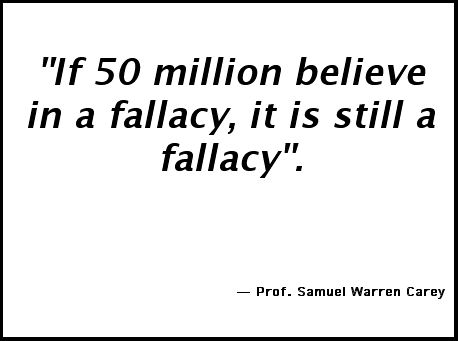
BANDWAGON
You appealed to popularity or the fact that many people do something as an attempted form of validation.
The flaw in this argument is that the popularity of an idea has absolutely no bearing on its validity.
If it did, then the Earth would have made itself flat for most of history to accommodate people's popular belief.

Example: Shamus pointed a drunken finger at Sean and asked him to explain how so many people could believe in leprechauns if they're only a silly old superstition. Sean, however, had had a few too many Guinness himself and fell off his chair.

APPEAL TO AUTHORITY
You used the opinion or position of an authority figure, or institution of authority, in place of an actual argument.
It is important to note with this fallacy that authorities in given fields may very well have valid arguments, and that one should not dismiss another's experience and expertise. To form an argument, however, one must defend it on its merits i.e. know why the person in authority holds the particular position that they do. It is, of course, entirely possible that the opinion of a person or institution of authority is wrong; therefore the authority that such a person or institution holds does not have any intrinsic bearing upon whether their claims are true or not.

Example: Not able to defend his position that evolution 'isn't true' Bob says that he knows a scientist who also questions evolution (and presumably isn't a primate).

NO TRUE SCOTSMAN
You made what could be called an appeal to purity as a way to dismiss relevant criticisms or flaws of your argument.
In this form of faulty reasoning one's belief is rendered unfalsifiable because no matter how compelling the evidence is, one simply shifts the goalposts so that it wouldn't apply to a supposedly 'true' example. This kind of post-rationalization is a way of avoiding valid criticisms of one's argument.

Example: Angus declares that Scotsmen do not put sugar on their porridge, to which Lachlan points out that he is a Scotsman and puts sugar on his porridge. Furious, like a true Scot, Angus yells that no true Scotsman sugars his porridge.

GENETIC
You judged something as either good or bad on the basis of where it comes from, or from whom it came.
This fallacy avoids the argument by shifting focus onto something's or someone's origins. It's similar to an ad hominem fallacy in that it leverages existing negative perceptions to make someone's argument look bad, without actually presenting a case for why the argument itself lacks merit.

Example: Accused on the 6 o'clock news of corruption and taking bribes, the senator said that we should all be very wary of the things we hear in the media, because we all know how very unreliable the media can be.

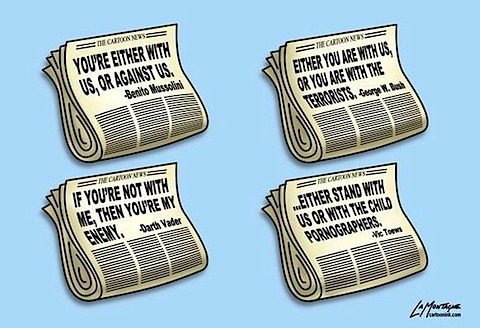
BLACK-OR-WHITE
You presented two alternative states as the only possibilities, when in fact more possibilities exist.
Also known as the false dilemma, this insidious tactic has the appearance of forming a logical argument, but under closer scrutiny it becomes evident that there are more possibilities than the either/or choice that is presented. Binary, black-or-white thinking doesn't allow for the many different variables, conditions, and contexts in which there would exist more than just the two possibilities put forth. It frames the argument misleadingly and obscures rational, honest debate.

Example: Whilst rallying support for his plan to fundamentally undermine citizens' rights, the Supreme Leader told the people they were either on his side, or they were on the side of the enemy. 

APPEAL TO NATURE
You argued that because something is 'natural' it is therefore valid, justified, inevitable, or ideal.
Just because something is natural does not mean that it's good. For instance murder is very natural, but most of us agree that we don't think it's a very good thing to be doing, nor does its 'naturalness' constitute any kind of justification for it.

Example: The medicine man rolled into town on his bandwagon offering various natural remedies, such as very special plain water. He said that it was only natural that people should be wary of 'artificial' medicines such as antibiotics.

ANECDOTAL
You used a personal experience or an isolated example instead of a sound argument or compelling evidence.
It's often much easier for people to believe someone's testimony as opposed to understanding complex data and variation across a continuum. Quantitative scientific measures are almost always more accurate than personal perceptions and experiences, but our inclination is to believe that which is tangible to us, and/or the word of someone we trust over a more 'abstract' statistical reality.

Example: Jason said that that was all cool and everything, but his grandfather smoked, like, 30 cigarettes a day and lived until 97 - so don't believe everything you read about meta analyses of methodologically sound studies showing proven causal relationships.

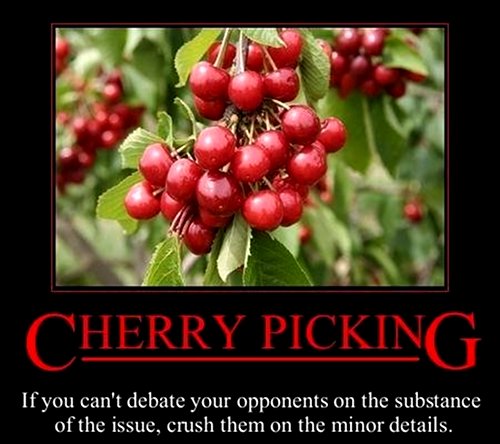
THE TEXAS SHARPSHOOTER
You cherry-picked a data cluster to suit your argument, or found a pattern to fit a presumption.
This 'false cause' fallacy is coined after a marksman shooting randomly at barns and then painting bullseye targets around the spot where the most bullet holes appear, making it appear as if he's a really good shot. Clusters naturally appear by chance, but don't necessarily indicate that there is a causal relationship.

Example: The makers of Sugarette Candy Drinks point to research showing that of the five countries where Sugarette drinks sell the most units, three of them are in the top ten healthiest countries on Earth, therefore Sugarette drinks are healthy.

MIDDLE GROUND
You claimed that a compromise, or middle point, between two extremes must be the truth.


Much of the time the truth does indeed lie between two extreme points, but this can bias our thinking: sometimes a thing is simply untrue and a compromise of it is also untrue. Half way between truth and a lie, is still a lie.

Example: Holly said that vaccinations caused autism in children, but her scientifically well-read friend Caleb said that this claim had been debunked and proven false. Their friend Alice offered a compromise that maybe vaccinations cause some autism, just not all autism.

Thursday, April 18, 2013

Science is not about certainty


"The very expression "scientifically proven" is a contradiction in terms.
There is nothing that is scientifically proven.
The core of science is the deep awareness that we have wrong ideas, we have prejudices.

Science is not about certainty.
Science is about finding the most reliable way of thinking at the present level o knowledge.

In fact, not only it's not certain, but it's the lack o certainty that grounds it.

Scientific ideas are credible not because they are sure, but because they are the ones that have survived all the possible past critiques and they are the most credible because they were put on the table or everybody’s criticism."
 - Carlo Rovelli

Source: Rationalhub.com

Why People Do Not Believe in Evolution (and why they should)

1. If humans came from apes, why aren’t apes evolving into humans?

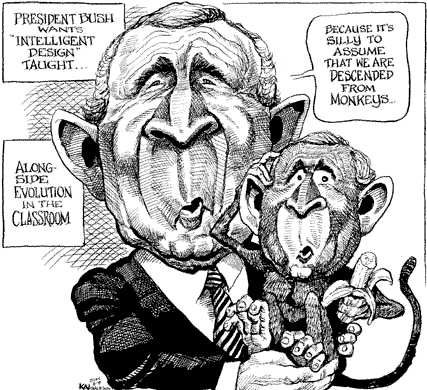
Humans, apes, and monkeys are only distant evolutionary “cousins.” We come not from apes but from a common ancestor that was neither ape nor human that lived millions of years in the past. In fact, during the last seven million years many human-like species have evolved; some examples include Homo habilis, Homo erectus, and Homo neanderthalensis. All of these went extinct at different times, leaving just us to share the planet with a handful of other primates.


2.There are too many gaps in the fossil record for evolution to be true.
In fact, there are lots of intermediate fossils. Archaeopteryx, for example, is one of the earliest known fossil birds with a reptilian skeleton and feathers. There is now evidence that some dinosaurs had hair and feathers. Therapsids are the intermediates between reptiles and mammals, Tiktaalik is an extinct lobe-finned fish intermediate to amphibians, there are now at least six intermediate fossil stages in the evolution of whales, and in human evolution there are at least a dozen intermediate fossil stages since hominids branched off from the great apes six million years ago. Considering the exceptionally low probability that a dead plant or animal will fossilize it is remarkable we have as many fossils as we do. First the dead animal has to escape the jaws of scavengers. Then is has to be buried under the rare circumstances that will cause it to fossilize instead of decay. Then geological forces have to somehow bring the fossil back to the surface to be discovered millions of years later by the handful of paleontologists looking for them.


3.No one has ever seen evolution happen.
Evolution is a historical science confirmed by the fact that so many independent lines of evidence converge to this single conclusion. Independent sets of data from geology, paleontology, botany, zoology, biogeography, comparative anatomy and physiology, genetics, molecular biology, developmental biology, embryology, population genetics, genome sequencing, and many other sciences each point to the conclusion that life evolved. Creationists demand “just one fossil transitional form” that shows evolution. But evolution is not proved through a single fossil. It is proved through a convergence of fossils, along with a convergence of genetic comparisons between species, and a convergence of anatomical and physiological comparisons between species, and many other lines of inquiry. (In fact we can see evolution happen—especially among organisms with short reproductive cycles that are subject to extreme environmental pressures. Knowledge of the evolution of viruses and bacteria is vital to medical science.)


4.If evolution happened gradually over millions of years why doesn’t the fossil record show gradual change?
Sudden changes in the fossil record are not missing evidence of gradualism; they are extant evidence of punctuation. Species are stable over long periods of time and so they leave plenty of fossils in the strata while in their stable state. The change from one species to another, however, happens relatively quickly (on a geological time scale) in a process called punctuated equilibrium. One species can give rise to a new species when a small “founder” group breaks away and becomes isolated from the ancestral group. This new founder group, as long as it remains small and detached, may experience relatively rapid change (large populations are genetically stable). The speciational change happens so rapidly that few fossils are left to record it. But once changed into a new species, the individuals will retain their phenotype for along time, leaving behind many well-preserved fossils. Millions of years later this process results in a fossil record that records mostly stability. The punctuation is there in between the equilibrium.

5.Science claims that evolution happens by random chance
Natural selection is not “random” nor does it operate by “chance.” Natural selection preserves the gains and eradicates the mistakes. To illustrate this, imagine a monkey at a typewriter. In order for the monkey to type the first 13 letters of Hamlet’s soliloquy by chance, it would take 2613 number of trials for success. This is 16 times as great as the total number of seconds that have elapsed in the lifetime of the solar system. But if each correct letter is preserved and each incorrect letter eradicated, the phrase “tobeornottobe” can be “selected for” in only 335 trials, or just seconds in a computer program. Richard Dawkins defines evolution as “random mutation plus nonrandom cumulative selection.” It is the cumulative selection that drives evolution. The eye evolved from a single, light sensitive spot in a cell into the complex eye of today not by chance, but through thousands of intermediate steps, each preserved because they made a better eye. Many of these steps still exist in nature in simpler organisms.

6.Only an Intelligent Designer could have made something as complex as an eye
The anatomy of the human eye shows that it is anything but “intelligently designed.” It is built upside down and backwards, with photons of light having to travel through the cornea, lens, aqueous fluid, blood vessels, ganglion cells, amacrine cells, horizontal cells, and bipolar cells, before reaching the light sensitive rods and cones that convert the light signal into neural impulses, which are then sent to the visual cortex at the back of the brain for processing into meaningful patterns. For optimal vision, why would an intelligent designer have built an eye upside-down and backwards? This “design” only makes sense if natural selection built eyes from available materials, and in the particular configuration of the ancestral organism’s pre-existing organic structures. The eye shows the pathways of evolutionary history, not intelligent design

7.Evolution is only a theory
All branches of science are based on theories, which are grounded in testable hypothesis and explain a large and diverse body of facts about the world. A theory is considered robust if it consistently predicts new phenomena that are subsequently observed. Facts are the world’s data. Theories are explanatory ideas about those data. Constructs and other non testable statements are not a part of science. The theory of evolution meets all the criteria of good science, as determined by Judge William Overton in the Arkansas creationism trial:
• It is guided by natural law.
• It has to be explanatory by reference to natural law.
• It is testable against the empirical world.
• Its conclusions are tentative.
• It is testable and falsifiable.
If you can find fossil mammals in the same geological strata as trilobites then evolution would be falsified. No one has ever found such contradictory data.

8.Evidence for Human Evolution Has Turned Out to Be Fake, Frauds, or Fanciful
Eager to discredit evolution, creationists ignore hominid fossil discoveries and cherry pick examples of hoaxes and mistakes in the belief that mistakes in science are a sign of weakness. This is a gross misunderstanding of the nature of science, which constantly advances by using both its mistakes and the successes. Its ability to build cumulatively on the past is how science progresses. The self-correcting feature of the scientific method is one of its most powerful assets. Hoaxes like Piltdown man, and honest mistakes like Nebraska Man, Calaveras Man, and Hespero-pithecus, are, in time, corrected. In fact, it wasn’t creationists who exposed these errors; it was scientists who did so. Creationists simply read about the scientific exposé of these errors, and then duplicitously claimed them as their own.

9.The second law of thermodynamics proves that evolution is impossible
The Second Law of Thermodynamics applies to closed, isolated systems. Since the Earth receives a constant input of energy from the sun—it is an open-dissipative system—entropy may decrease and order increase (though the sun itself is running down in the process).Thus, the Earth is not strictly a closed system and life may evolve without violating natural law. As long as the sun is burning, life may continue thriving and evolving, just like automobiles may be prevented from rusting, burgers can be heated in ovens, and all manner of things in apparent violation of Second Law entropy may continue. But as soon as the sun burns out, entropy will take its course and life on Earth will cease.

10.Evolution can’t account for morality
As a social primate species we evolved a deep sense of right and wrong in order to accentuate and reward reciprocity and cooperation, and to attenuate and punish excessive selfishness and free riding. As well, evolution created the moral emotions that tell us that lying, adultery, and stealing are wrong because they destroy trust inhuman relationships that depend on truthtelling, fidelity, and respect for property. It would not be possible for asocial primate species to survive without some moral sense. On the constitution of human nature is built the constitutions of human societies.


Source: 2010 Skeptics Society

Thursday, March 14, 2013

Let’s set it straight (pun intended)


These past few days, a cancer-causing article has circulated throughout the Internet. The article ‘Being Gay’ written by Tintin Babao where she supposedly consulted an “expert” on homosexuality has made me want to punch my desktop’s screen while reading it. I just cannot believe that a psychologist with a doctorate degree can be that... that... and a parent who supposedly loves her son unconditionally can hold such a ... such a... view (just fill the ellipsis with the bitchiest and most affronting words and phraseology you know).


Anyway, this write up is not about me lambasting their ignorance and bigotry (you judge) dressed in religious overcoat. I just want to get things straight (pun again) by putting a blow-by-blow (pun again) commentary on some parts of the article I find completely retarded. Anyway, I would also be speaking from an LGBT’s point of view because I am one, a bisexual.

“Remember ang binigay ng Diyos na anak is a girl or boy. A six-year-old can already identify his/her gender. Good parenting structures the right role of a person.” 


The answer provided by Dr. Camille implies that gender is the same with sexual orientation. One’s gender, the “socially constructed expectations, roles, and behaviors given by a particular society for men and women” is completely different from sexual orientation. Sexual orientation, to put simply, is whom you are attracted to. Doctor Camille seems to say that if only parents will socialize their children to be masculine or act like a man as perceived by society, parents can stop them from being homosexual. This kind of orientation is bogus. You cannot modify someone’s sexual orientation: 

All major national mental health organizations have officially expressed concerns about therapies promoted to modify sexual orientation. To date, there has been no scientifically adequate research to show that therapy aimed at changing sexual orientation (sometimes called reparative or conversion therapy) is safe or effective. Furthermore, it seems likely that the promotion of change therapies reinforces stereotypes and contributes to a negative climate for lesbian, gay, and bisexual persons. This appears to be especially likely for lesbian, gay, and bisexual individuals who grow up in more conservative religious settings (APA).

One can be as gay as they are but still ‘act’ like a cisgender. Also, the girl-boy binary has long been debunked; intersex individuals exist. 


Should parents be alarmed and arrest the situation? Or encourage it? Dr. Camille: “Arrest the situation, ’yun ang tama. But most parents encourage the situation. Tatanggapin agad. Let’s be moral in making the child understand the situation, di ba yun ang dapat. We tell our child, ‘Anak, mali ito.’” 

How should the parents address this? Some parents resort to threat and extreme military-style punishment. Some parents go to great lengths to explain to the child the consequences of being gay, so that the child can think, then make a choice.Dr. Camille: “Threat and punishment encourage the child more to do things wrongly, because you are shutting off the situation. Make sure you discuss with your child openly. ‘Alam mo anak, hindi namin gusto yung ginugusto mo.’


People like her still thinks that being a homosexual is wrong and immoral. This mode of thinking has pushed gay people to take their lives because of rejection, marginalization, and depression.  LGBT youth who were living in an unaccepting environment have an increased risk for suicide. I am not really into the nitty-gritty of what other people consider as immoral, but I am pretty sure that to drive your child into his death qualifies as wrong and an immoral act. 


“Explain that he is a boy and therefore, as boys, they grow up as men and their partners are women. ‘Hindi kasi tama ang makasama sa buhay at magpapamilya ay parehas na lalaki.

No. Downright no. Same-sex families can raise a beautiful family and lovely children. (No one can dictate you who to spend your life with.) They have very fabulous and heart-warming weddings too!  

As a mom who has a three-year-old son named Nio, my personal take on the matter is this: Nio, when curious, plays with his big sister’s toys. But we always point it out to him that those are toys for girls, and these are toys for boys. We compare toys so that he will understand.Before he turned three, he was fully aware and could already distinguish the girls’ toys from the boys’ toys. We realized that playing with his big sister’s toys is his loving way of bonding and playing with his Ate Antonia. When big sister is not around, Nio doesn’t touch the girly toys.


Heteronormativity. This is heteronormative bullshit. Just to add, I have and loved all the toys that can symbolize machismo: trains, Hot Wheels, light sabers, superhero action figures, RC helicopters and cars. But see, I am a bisexual. 


That's it. I still want to add more but time won't allow. Still have things to do. 
Bye! And this is for you Tintin and Dr. Camille: 


I'M BEAUTIFUL IN MY WAY/
COZ GOD MAKES NO MISTAKES/
I'M ON THE RIGHT TRACK BABY/
I WAS BORN THIS WAY/